

Government MBBS vs Private MBBS 2026: Which is Better? Complete Comparison of Fees, ROI, Placements & Career Scope
After qualifying NEET UG, one of the biggest decisions every medical aspirant faces is choosing between a Government MBBS vs Private MBBS college. While both types of institutions award an MBBS degree recognized by the National Medical Commission (NMC), they differ significantly in tuition fees, admission competition, infrastructure, patient exposure, return on investment (ROI), and overall learning environment.
Government medical colleges are generally known for affordable education and high patient inflow, whereas private medical colleges often provide modern infrastructure, advanced facilities, and additional seat availability. However, the right choice depends on your NEET score, counselling outcome, financial capacity, career goals, and preferred location.
This comprehensive guide compares Government MBBS vs Private MBBS across every important factor to help students and parents make an informed admission decision for MBBS Admission 2026.
Government MBBS vs Private MBBS: Overview
Government medical colleges are funded by the Central or State Government and admit students primarily through NEET UG counselling conducted by the Medical Counselling Committee (MCC) and respective state counselling authorities.
Private medical colleges are managed by educational trusts, universities, or private organizations. Admission is also based on NEET UG scores, with counselling conducted through state authorities or deemed university counselling, depending on the institution.
Regardless of the college type, only NMC-approved medical colleges can offer valid MBBS degrees in India.
Government MBBS vs Private MBBS: Quick Comparison
| Feature | Government MBBS | Private MBBS |
|---|---|---|
| Admission | NEET + Counselling | NEET + Counselling |
| Recognition | NMC Approved | NMC Approved |
| Tuition Fees | Lower | Higher |
| Competition | Very High | Moderate to High |
| Clinical Exposure | Usually High | Depends on Hospital |
| Infrastructure | Good to Excellent | Good to Excellent |
| Hostel Facilities | Available | Available |
| ROI | Excellent | Depends on Fees |
| Degree Value | Equal | Equal |
Admission Process
The admission process for both government and private medical colleges begins with qualifying NEET UG.
Candidates must:
- Appear for NEET UG.
- Obtain a qualifying score.
- Register for counselling.
- Complete choice filling.
- Participate in seat allotment.
- Report to the allotted college.
Government seats are allotted mainly through All India Quota (AIQ) and State Quota, while private college admissions may also include deemed university counselling where applicable.
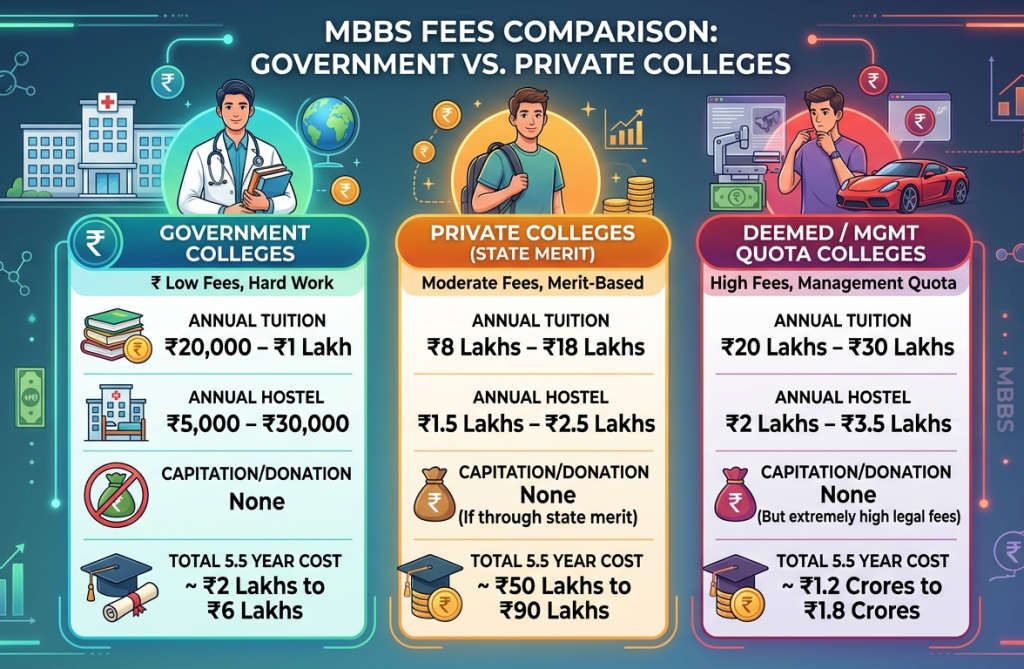
Government MBBS vs Private MBBS: Fees Comparison

One of the biggest differences between Government MBBS vs Private MBBS is tuition cost.
Government medical colleges generally receive government funding, allowing them to charge substantially lower tuition fees.
Private medical colleges usually have higher tuition fees because operational costs are funded primarily through student fees and institutional resources.
Students should always verify the latest fee structure from the official college website before participating in counselling.
Clinical Exposure
Clinical exposure is one of the most important aspects of medical education.
Government hospitals often receive a very high patient load, giving students extensive opportunities to observe and manage diverse medical cases.
Many reputed private medical colleges also maintain large teaching hospitals that provide quality clinical training.
Before selecting a college, students should evaluate:
- Hospital bed strength
- Daily OPD attendance
- Emergency services
- Specialty departments
- Internship opportunities
rather than relying solely on whether the institution is government or private.
Infrastructure Comparison
Private medical colleges frequently invest in:
- Smart classrooms
- Simulation laboratories
- Digital libraries
- Modern anatomy labs
- Research centres
- Advanced diagnostic equipment
Government colleges may have older campuses but often possess well-established departments, experienced faculty, and excellent clinical facilities.
Faculty and Academic Environment
Both government and private medical colleges employ qualified faculty members in accordance with NMC regulations.
Students should consider:
- Faculty experience
- Student-to-teacher ratio
- Research opportunities
- Academic performance
- Internship quality
instead of making decisions based only on ownership.
Placements and Career Opportunities
Unlike engineering courses, MBBS graduates usually do not participate in traditional campus placements.
After graduation, students commonly pursue careers as:
- Junior Resident Doctors
- Medical Officers
- General Practitioners
- Government Doctors
- Private Hospital Doctors
- Clinical Researchers
- Public Health Professionals
Many graduates also prepare for:
- NEET PG
- INI-CET
- Foreign Licensing Exams
- MD/MS Specializations
The career opportunities after MBBS depend more on individual performance and postgraduate specialization than on whether the degree was earned from a government or private college.
Return on Investment (ROI)
ROI is a major deciding factor in the Government MBBS vs Private MBBS comparison.
Government medical colleges generally provide a stronger financial return because of significantly lower educational expenses.
Private medical colleges may still offer excellent career outcomes, but students should carefully assess:
- Tuition fees
- Hostel charges
- Living expenses
- Scholarship availability
- Long-term financial planning
before making a decision.
Government MBBS vs Private MBBS: Which Offers Better Clinical Training?
Government hospitals generally expose students to:
- Higher patient volume
- More emergency cases
- Diverse disease profiles
- Greater hands-on learning opportunities
However, several reputed private institutions also provide excellent teaching hospitals with modern medical equipment and experienced clinicians.
Students should evaluate individual colleges rather than assuming one category is always superior.
Advantages of Government MBBS
Government medical colleges offer:
- Affordable tuition fees
- Excellent clinical exposure
- Strong academic reputation
- High patient inflow
- Better ROI
- Extensive alumni network
- Government hospital experience
Advantages of Private MBBS
Private medical colleges provide:
- Modern infrastructure
- Advanced laboratories
- Well-equipped classrooms
- Additional seat availability
- Better campus facilities
- Smaller batch sizes in some institutions
- International collaborations in selected colleges
Common Myths
Myth 1: Government MBBS Is Always Better
Not necessarily.
Many private medical colleges deliver excellent academic training, modern facilities, and strong internship opportunities.
Myth 2: Private MBBS Graduates Cannot Get Good Jobs
Incorrect.
Graduates from NMC-approved private medical colleges are eligible for the same licensing, postgraduate entrance examinations, and employment opportunities as government college graduates.
Myth 3: Only Government Doctors Become Successful
Success depends on:
- Medical knowledge
- Clinical skills
- Communication
- Continuous learning
- Postgraduate specialization
- Professional ethics
rather than the ownership of the college.
How to Choose Between Government MBBS vs Private MBBS
Before making your final decision, consider:
- NEET Rank
- Budget
- Counselling Results
- College Reputation
- Hospital Facilities
- Faculty
- Internship Opportunities
- Location
- Hostel Facilities
- Postgraduate Preparation Environment
Expert Tips
- Participate in every counselling round.
- Research colleges thoroughly.
- Verify NMC recognition.
- Compare hospital exposure.
- Do not make decisions based only on fees.
- Review previous years’ cutoffs.
- Consider long-term career goals.
Related Articles
You may also find these guides helpful:
- Top Medical Colleges in India for MBBS Admission 2026
- MBBS Top Colleges in Bangalore | Complete 2026 Admission Guide
- Top Engineering Colleges in Bangalore
- NEET Counselling 2026
- NEET UG 2026 Complete Guide
- NEET UG 2026 OMR Sheet Instructions
- NEET UG 2026 Admit Card Released
- Re-NEET UG Result 2026 Expected by July 20: Complete Guide to Result Date, Scorecard, Cutoff & Counselling
Official Resources
Students should always refer to official sources for updated information:
- National Eligibility cum Entrance Test (NTA): https://neet.nta.nic.in
- Medical Counselling Committee (MCC): https://mcc.nic.in
- National Medical Commission (NMC): https://www.nmc.org.in
- Ministry of Health & Family Welfare: https://www.mohfw.gov.in
Frequently Asked Questions
Is Government MBBS better than Private MBBS?
Government MBBS generally offers lower tuition fees and high clinical exposure, while private MBBS may provide modern infrastructure and additional seat availability. The best choice depends on your NEET rank, budget, career goals, and preferred college.
Is the MBBS degree the same in Government and Private Colleges?
Yes. Both government and private colleges award valid MBBS degrees if the institution is approved by the National Medical Commission (NMC).
Is NEET compulsory for Government and Private MBBS?
Yes. Qualifying NEET UG is mandatory for admission to both government and private MBBS colleges in India.
Which has better ROI?
Government MBBS generally provides a stronger return on investment because tuition fees are significantly lower than those at most private medical colleges.
Can Private MBBS students become Government Doctors?
Yes. Graduates from NMC-approved private medical colleges can apply for government jobs, postgraduate medical education, and licensing examinations after meeting the prescribed eligibility requirements.
Conclusion
The debate over Government MBBS vs Private MBBS does not have a single correct answer. Government medical colleges are highly competitive, affordable, and offer excellent clinical exposure, making them the preferred choice for many students. Private medical colleges, on the other hand, provide additional admission opportunities, modern infrastructure, and quality education in many institutions.
Ultimately, the best choice depends on your NEET score, counselling outcome, financial capacity, preferred location, and long-term career aspirations. Instead of focusing only on the college type, evaluate the institution’s NMC approval, teaching hospital, faculty, academic performance, and internship opportunities before making your final decision.
Need MBBS Admission Guidance?
MELTA EduPath helps students with:
- MBBS Admission 2026
- NEET Counselling
- Government & Private Medical Colleges
- College Selection
- State Quota & All India Quota Guidance
- Deemed University Admissions
📞 Call / WhatsApp: +91 9110231169
✉ Email: admission@meltaedupath.in
🌐 Website: www.meltaedupath.in